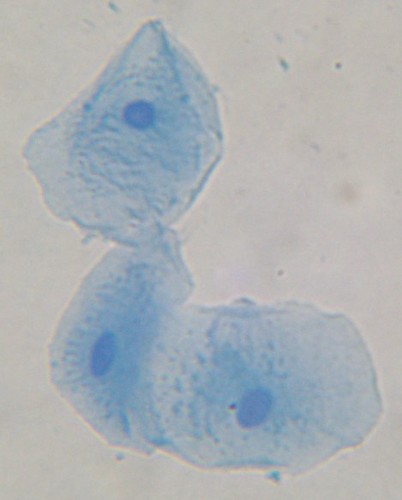
In class we continued the Cell Lab which the former scribe briefly described. Today however we looked at onion cells (a plant cell unlike our cheek cell which is an animal cell). We peeled the skin off the outside of the onion to do this. First we looked at them with water at 40x magnification then drew what we saw. Then we added a drop of methyl blue stain and looked at it again with 40x magnification and drew what we saw again. After that we looked at cell at 100x magnification. This was more detailed and we could see more of the cell. I personally thought that the onion cells were more interesting than the cheek cells. I found the folded parts of the onion skin very interesting. However we were supposed to avoid this as much as possible because Ms. D. only wanted us to see the flat part so we could see all the aspects of the cell. For the final part of the lab we had to answer three questions about our observations. If you have anymore questions about the lab the instructions can be found on the 7th grade Moodle.
After we finished the lab Ms. D. passed around some slides with interesting materials on it. There were three with skin, one with bone, and one with a plant ( I forget the name). They all looked very interesting under a microscope and if you have the chance you should look at them. Next MS. D. took out a microscope that when you put it in front of something it showed that. It wasn't a conventional microscope. It hooked up to the computer and we looked at some things that couldn't be put on a slide. Some examples of these are an eye, fabric, a paperclip, and writing ( very large on the screen).
For the remainder of class we discussed our note taken on chapter 1. We did not get very far because we were off task a lot talking about random things related to the human body (will be explained in description). Our first question was on the levels of organization of the human body. In the discussion we went past and before the human body. Ms. D. told us the whole chain. It is as follows (smallest to largest):
Quarkselectrons/protons/neutronsatomsmolecules
organelles
cells
tissue
organs
organ systems
organism
species
genus
family
order
class
phylumkingdom
Then we listed the six kingdoms of life which all this living matter falls under.
 The second question past without exaggeration but on the third question when we were talking about the types of tissue we discussed how epithelial tissue lines the inside of the stomach. From this we went into what stomach acid could do to you. We found out that it could make an ulcer and cause you extreme discomfort and if it leaked out the acid could dissolve your whole body until you literally were just skin and bones. You would then starve to death because all you reserves would be gone( a terrible way to die). Again when we were talking about connective tissue we somehow got to bone marrow transplants. We learned that in order to do have a successful operation you couldn't be "put to sleep" but a needle had to be stuck through you skin and bone into the marrow. This method is also used in a spinal tap but that is in between two vertebra. The two next question were what was an organ or organ system. Originating from that question we discussed what would happen if you didn't have some of your organ systems. All of them got to the same point: you wouldn't be here. In the case of the excretory system the waste would build up inside you and you would swell until you burst sending body flying everywhere. This shows that all of the systems are important, no matter how unimportant they seem.
What we did in class today directly relates to real life in many ways. We were looking and discussing parts of us for one thing. This knowledge will hopefully help us understand ourselves better.
Here is a link to a video that animates human body features and movements enjoy.
After finishing everything we had our break and went to the bodies revealed exhibit which will be explained by the Noam and she will chose the next scribe.